Everything you need to design the right plaque — materials, sizes, finishes, mounting, and more. Pick a topic to dive in, or read the basics below.
Click any topic to read more.
This guide has a lot of information. Use the topics above to jump to a specific subject. If you have a question that isn’t answered here, or need additional support, email us at sales@americancastbronzeplaques.com.
If you’re working from a construction specification, you’ll find signage listed under CSI MasterFormat Division 10 — “Specialties” — within Section 10 14 00. That one section covers a surprisingly broad slate of products, and knowing what falls under it makes ordering far simpler. As a Division 10 signage supplier, we provide all of it under one roof: cast bronze and aluminum plaques, etched and engraved panels, dimensional letters and logos, ADA-compliant tactile and Braille signage, room and door identification, directories, code and egress signs, and exterior monument or building-mounted signage. Sourcing everything through a single supplier keeps your finishes consistent, your lead times aligned, and your submittals coming from one accountable source — which matters when a project’s signage has to match across dozens of rooms and entrances.

Designing cast bronze plaques is not too difficult as long as you follow some basic guidelines. The most basic type of plaque is one that has just words. Once you start adding elements like logos, photos, and other designs, then you need to be aware of additional restraints. There are other informational topics that will provide you with more information on those subjects.
The simplest type of plaque uses the same font height throughout the plaque. This is one of the most common methods, especially if you have limited room. One of the most important things you need to know is the minimum letter size.
From the very beginning, you should have a good idea of what you want your plaque to look like. Some want a plaque that is artistic looking with different font styles and heights. Others are looking for plain plaques that provide basic information. If you are looking for a small plaque, or one that fits in a particular area, then you may find that the amount of information that you can put on the plaque is quite limiting. If size is not an issue, then you have the freedom to add lots of different types of elements. The only thing that will limit what you do is the final price.
The majority of options on plaques do not add additional charges; however, the bigger the plaque the more expensive it will be. The overall price can increase quickly since pricing is based on the overall square inches of the plaque, and the bigger the plaque the thicker it must be, so as plaques get larger the price can quickly escalate.
In order to help with pricing, we try to provide an all-inclusive price. That being said, there are some options that do indeed have an impact on the price, such as the use of photos, multiple paint colors, stakes and posts, or if you want the plaque polished.
The vast majority of plaques use all uppercase letters. For those not used to metal plaques it may seem strange to use all uppercase letters, but this is the industry standard. Nothing stops you from using upper and lowercase letters, but due to minimum font sizes in cast bronze plaques you should be aware of the impact.
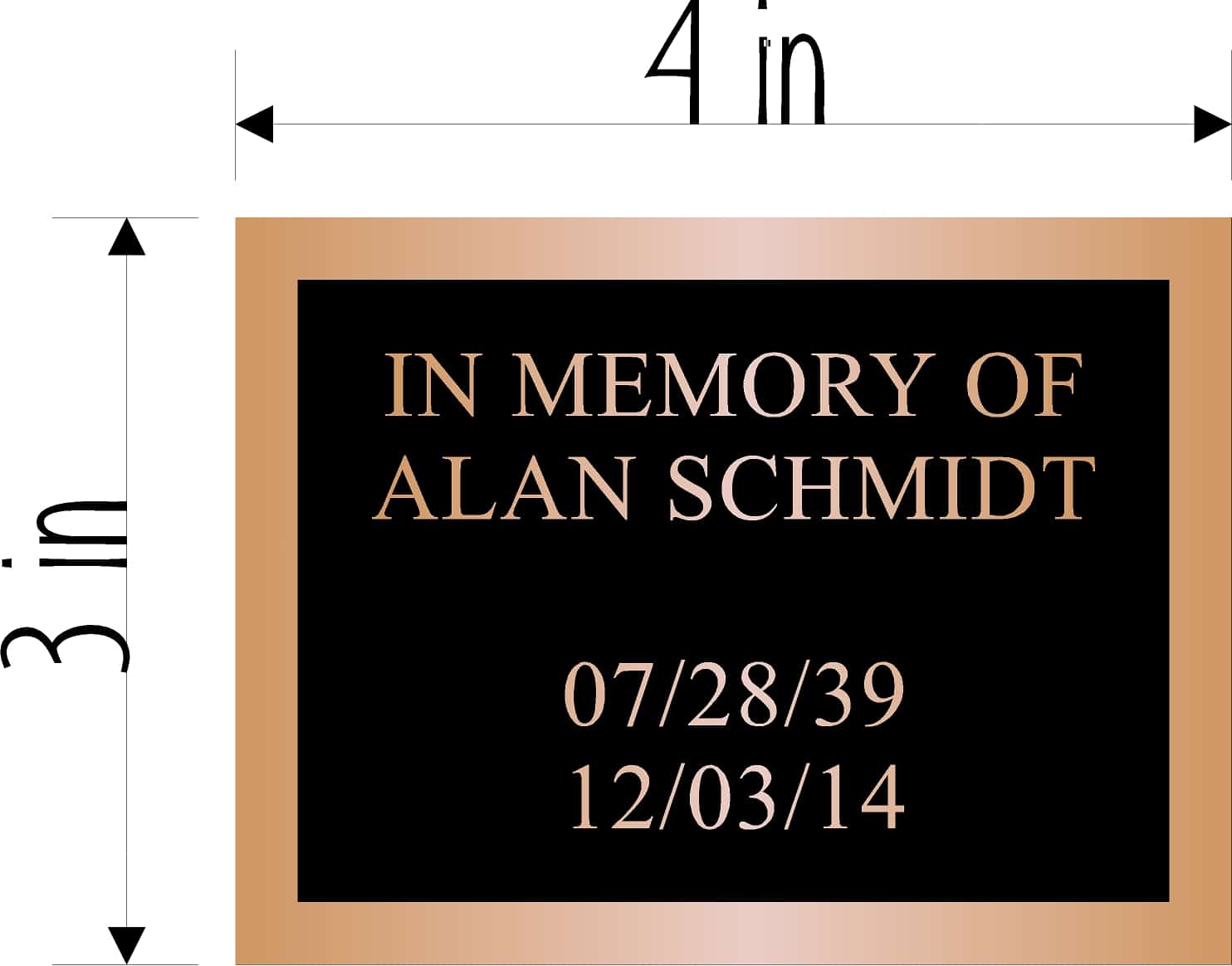
The casting process requires a certain thickness on the raised letters. Too small of letters will crumble and fail after casting. So, if you are using all uppercase letters, the minimum font height is .25″.
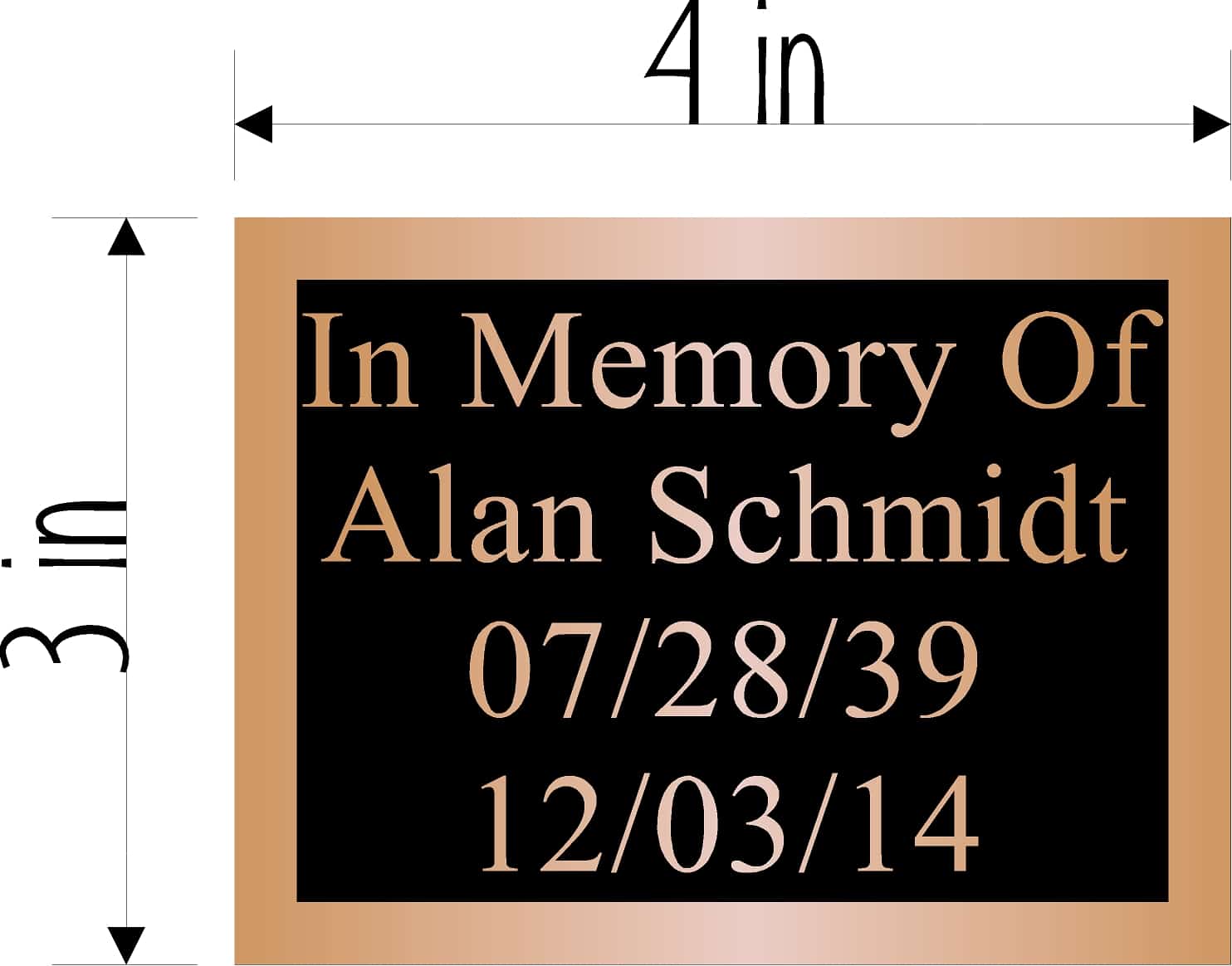
If you want to use lowercase letters, then we need to make sure that none of the letters are smaller than the .25″ size standard. We have calculated that .375″ font height makes sure that the lowercase letters are no smaller than .25″.
To provide a visual, the upper plaque has all uppercase letters at .25″. The lower plaque has lowercase letters sized at .375″. You can see the impact that can have on a plaque — especially if you have a lot of text, or a limited plaque size.
The majority of cast bronze plaques use four background colors: Black, Brown, Duranodic Bronze, and Dark Oxide. Of these four colors, black by far is the most commonly chosen. This does not mean you are limited to just these four colors — If you are looking for another background color, choose Custom PMS Color in the Background Color options on any plaque.
There are four textures to choose from: Stipple, Leatherette, Pebble, and Sand. Of these, the most common is stipple. Usually larger plaques look nice with the leatherette finish.
There are two finish options — brushed and polished. Brushed is the standard and is by far the most popular. You can choose to have the plaques polished to give them a high shine; however, this process adds a 50% charge and is best reserved for smaller, less expensive plaques.
The clear coat options are self-explanatory: Gloss, Semi-Gloss, Satin, and Matte. The default option is Satin and is the most popular. The second most popular is matte. If you are choosing a polished finish, then you would also want to choose a gloss clear coat — anything else would diminish the polished look.
The most common types of borders are the Single Line Border and Double Line Border, followed by the same but with beveled edges. Borders are purely for decoration and you can choose whichever one you think looks best. The one thing to keep in mind is that if you are limited for space, or are designing a small plaque, the borders can take up a lot of space; furthermore, the use of rosettes can also encroach on your typeset area. So, if your plaque is too small for the amount of text and border, you may have to either choose a larger plaque size or omit the border altogether.
We offer a number of border options to choose from, but all are pretty basic in style. We also have available some fancier border options, but those add cost to the plaque.
Here is an explanation of all the mounting options:
One of the most common mounting options. This is meant to be a permanent installation, and all hardware is hidden. The back of the plaque has threaded holes drilled, and threaded rods are provided. You screw the rods into the back of the plaque, then drill holes into your stone or other solid surface. The holes are filled with epoxy, and the plaque with rods is set into place. Once dried, the plaque is locked in.
Also meant for a solid surface, such as stone or a concrete wall. The difference from blind mount is that the hardware is visible on the plaque. Holes are predrilled into the surface, then screws / bolts anchor the plaque to the wall. This method is good if you ever want to remove the plaque in the future.
Good for attaching a plaque to drywall or other hollow walls. This option uses toggle bolts that anchor inside the hollow wall. The hardware is visible.
For attaching a plaque to a surface that screws can be driven into.
The minimum plaque height needed for a stake mount is 4″. Meant for small plaques placed in gardens, in front of trees, or anywhere you want the ability to remove and replace. Stakes come in three lengths: 24″, 36″, and 48″. Push the stake at least 12″ into the ground for stability; final height depends on stake length and plaque height.
The minimum plaque height needed for a post mount is 8″. Meant for a permanent installation above the ground. Posts are concreted into the ground. The nice thing about post mounts is there are two display options — vertical at a 90-degree angle, or at a 45-degree angle. The posts are specially designed to attach to the post mount on the back of the plaque and are not typical post sizes.
Rosettes are decorative covers for the mounting hardware — purely decorative and not necessary. Blind mount plaques do not require any type of rosette. The other mounting options can use rosettes to either completely hide the screw or make it more attractive. Rosettes are usually permanently attached to the plaque using silicone glue.
Etched plaques are the reverse of cast bronze plaques. Etched plaques have recessed letters that are painted. They offer more detail possibilities, so if you are tight on overall size and need more letters than a traditional cast bronze plaque can offer, then an etched plaque might be your best choice. There are still restrictions on line thickness and minimum font height, but that also depends on the font. Sans-serif fonts, like Arial, allow for smaller fonts such as .13″, while serif fonts like Times have a minimum font height of .2″.
Etched plaques are also good when you have a detailed logo or drawing that needs to be on a plaque, since they allow all of the text and logo to be integrated on one surface. Sometimes customers request a cast bronze plaque but need a state seal or logo — in those cases, we can have the seal or logo etched on a round etched metal and then permanently attached to the cast bronze plaque.
There are many reasons customers choose aluminum plaques. Sometimes it’s because they need a lightweight option; other times they’re looking for a less expensive plaque. Cast aluminum is the way to go when you are on a budget and need a light plaque option.
Because cast aluminum plaques are less expensive and lightweight, they are often chosen for monument or historical place markers. These plaques are usually painted with multiple colors, such as a dark green or blue background with white lettering.
Donation and memorial plaques usually require a bit more care in the planning and design. These types of plaques often have lists of names and particular layouts. The most common approach is to have all the names cast or etched right into the plaque, while other times customers need individual plates that can be screwed onto the plaque for years to come. No matter which option you need, we can help you choose the right size and layout for your project.
Tell us what you have in mind and we’ll help you choose the right size, material, and finish — then send a free proof.